






How to choose lash tweezers that make you faster and hurt less
 Kru May
Maison du Cil Thailand · 14 September 2026
Kru May
Maison du Cil Thailand · 14 September 2026
In this article
Tweezer shapes and the job each one does Three things that matter more than the shape Signs it's time to replace your tweezers Care that genuinely extends their life How many should you own?Most lash artists invest seriously in their adhesive, but carry on with the same tweezers for three years without ever questioning them — even though the tweezers are the one thing in your hand the entire time you work, and the thing that decides whether your fingertips ache by the evening.
This article explains what each shape is for, and how to tell when yours need replacing.
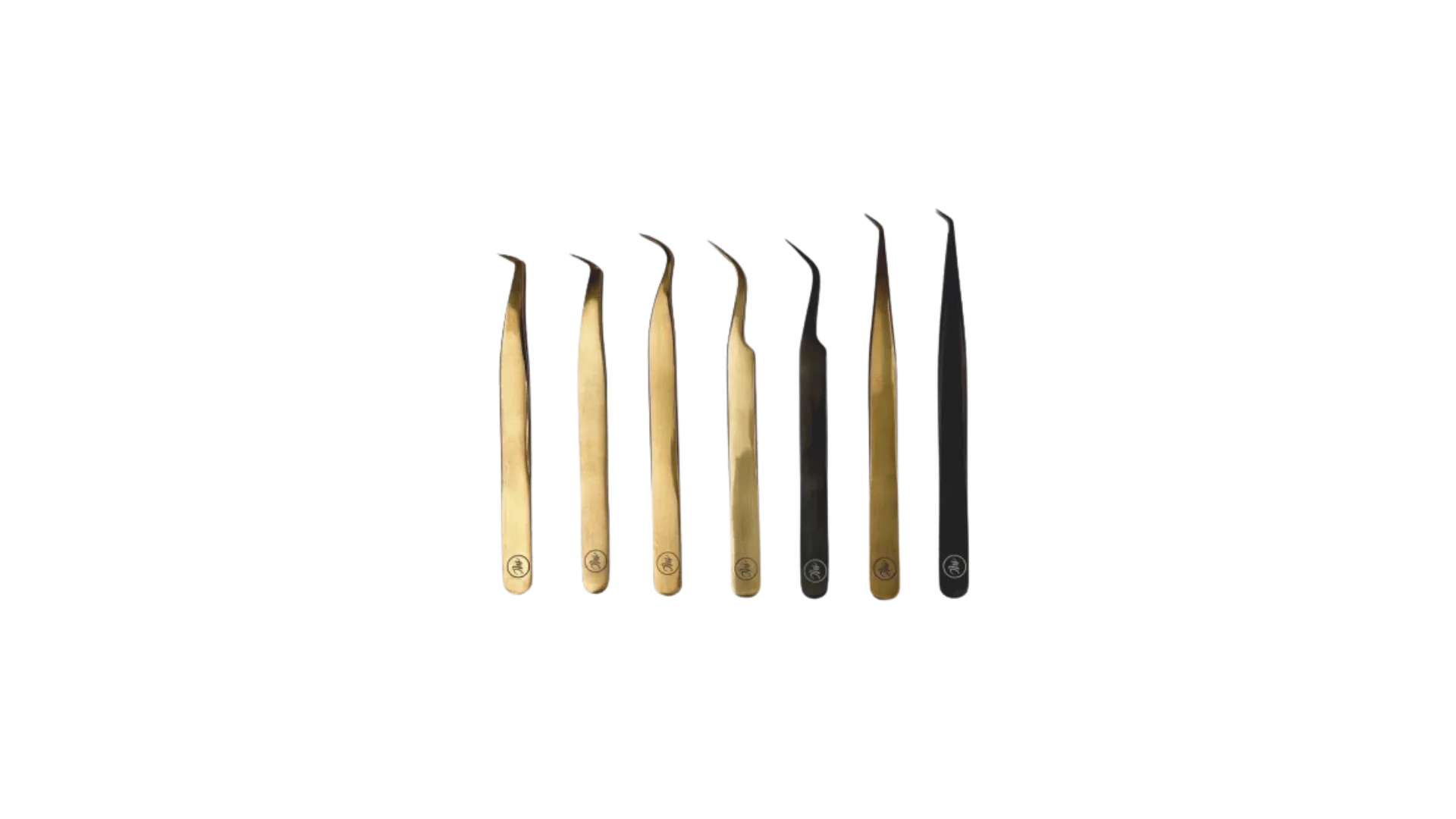
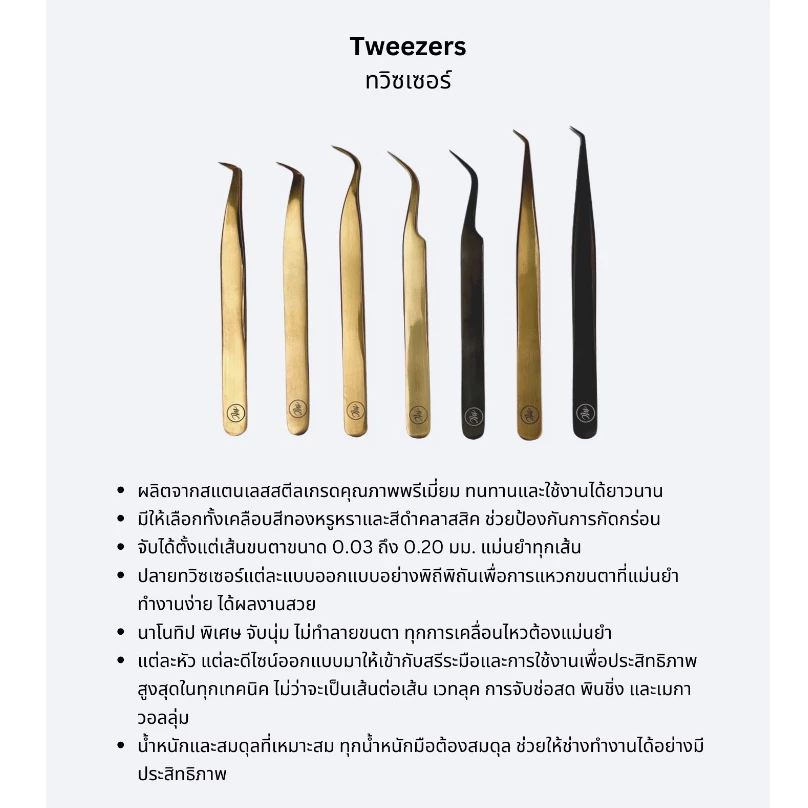
Tweezer shapes and the job each one does
Straight tweezers (I / straight)
Straight, long tips. Used mainly for isolating natural lashes The straight, tapered tip lets you slide in between lashes without pushing the neighbouring ones out of place.
Some artists also pick up extensions with straight tweezers, which works, but requires more wrist rotation to place onto the natural lash.
Curved tweezers (L-curve / 45°)
Angled tips. Used for picking up and placing extensions The angle lets you see the point you're placing onto without raising your hand into your own line of sight, and it keeps the wrist in a more natural position.
For artists with wrist or shoulder pain, switching from straight to curved tweezers for the placement step usually helps more immediately than buying a new chair.
U-curve tweezers (deep curve)
Used specifically for making volume fans The deep curve gathers several lashes evenly at the tip, producing a fan with a narrow base and a consistently even spread.
If you still work mainly classic, you don't need these yet.
Wide-tip tweezers (Spidy / multi-lash)
Designed to pick several lashes off the strip at once. They save a lot of time in mega volume, but need real proficiency — not for someone just starting volume.
Three things that matter more than the shape
1. Closing tension at the tip
This is what separates good tweezers from ordinary ones, and it's the one thing you cannot judge from a product photo.
Good tweezers close completely under very light pressure. You can hold them loosely all day without tensing. Tweezers that are too stiff force you to squeeze constantly, which builds into thumb and index-finger pain within a few months.
A simple test: pick up a single hair. If you have to squeeze harder than feels comfortable, they're too stiff for you.
2. The tips must align perfectly
Hold the tweezers up to the light. If there's even the slightest gap at the tip, you won't pick up a single lash accurately — and you'll feel like your hands are “off today” when it's actually the tool.
Misaligned tips usually come from dropping them, or from using tweezers to lever open a glue bottle, which almost every artist has done.
3. Weight and balance
Tweezers that are too heavy make your wrist work harder across a three-hour appointment. Too light and they're hard to control, because there's no counterweight.
Good balance means the centre of gravity sits exactly where your fingers hold them. If the tip feels like it's tipping downward, you'll be tensing to hold it up.
Signs it's time to replace your tweezers
- You have to squeeze harder than before to grip
- Lashes slip off the tip more often
- Glue residue has built up at the tip and no longer wipes off
- The tips no longer align when held up to the light
- Thumb or wrist pain after work, where there wasn't any before
There's no fixed lifespan. Artists doing 3–4 clients a day usually replace their main tweezers every 8–12 months.
Care that genuinely extends their life
- Wipe the glue off immediately after every client Before it dries. Use a cotton pad with glue remover and wipe from base to tip in one direction.
- Never scrape glue off with anything hard This is the number one cause of misaligned tips.
- Put them back in their sleeve every time Even if they're only sitting on the table for a moment.
- Don't use your tweezers for anything else No levering lids, no picking things up, no pulling tape.
- Disinfect with 70% alcohol Then dry them completely. Residual moisture causes rust, even in stainless steel.
How many should you own?
For artists working mainly classic, two is enough: straight for isolation, curved for placement.
For artists doing volume as well, three — adding a U-curve.
Worth more than owning many is owning a spare of the model that suits you best. On the day your main pair gets dropped and bent, you won't have to work a full day with an unfamiliar tool.
Not sure which tweezers suit your hands? Ask Kru May on LINE @maisonducil Tell us what kind of work you do and where the pain is — we'll point you in the right direction.
An online lash extension course with Kru May: learn anywhere, any time, with a French certificate and a support group that answers every question.
- Launch price
- 48 hours of early access
- A free lesson, soon
A question about your own work? Message Kru May on LINE Monday–Saturday, 10:00–19:00