





How to choose a lash adhesive that matches your hand speed
 Kru May
Maison du Cil Thailand · 14 September 2026
Kru May
Maison du Cil Thailand · 14 September 2026
In this article
What “2 seconds” actually means A simple way to measure your own hand speed Which glue suits whom Three signs your glue is too fast for you Two signs your glue is too slow for you What matters more than which glue you pick How long glue lasts once opened In shortThe question we get most often on LINE is “all three glues cost the same, so what's the difference?” The shortest answer is: the setting time. And you should choose that setting time by your hand speed, not by the level you'd like to be at.
This article explains what that number actually means, and how to choose so you don't waste money on the wrong bottle.
What “2 seconds” actually means
The number on the bottle is how long the glue takes to set enough to bond two lashes together, counted from the moment it touches the natural lash.
What people get wrong is reading it as “the time I have to work”. It is really a deadline you have to have the extension in position before that moment — not exactly on it.
So if you use a 1-second glue, you actually have around 0.7 seconds to pick up, dip, isolate and place. For a lot of people, that's far too fast.
A simple way to measure your own hand speed
Before choosing a glue, know your own number. Try this on your next client.
- Time yourself from dipping the glue to finishing the placement of one lash.
- Repeat for 10 lashes and take the average.
- Add half a second to that average as a margin.
The result is the minimum setting time you should be using. If you get 1.8 seconds, don't go anywhere near a 1-second glue.
Which glue suits whom
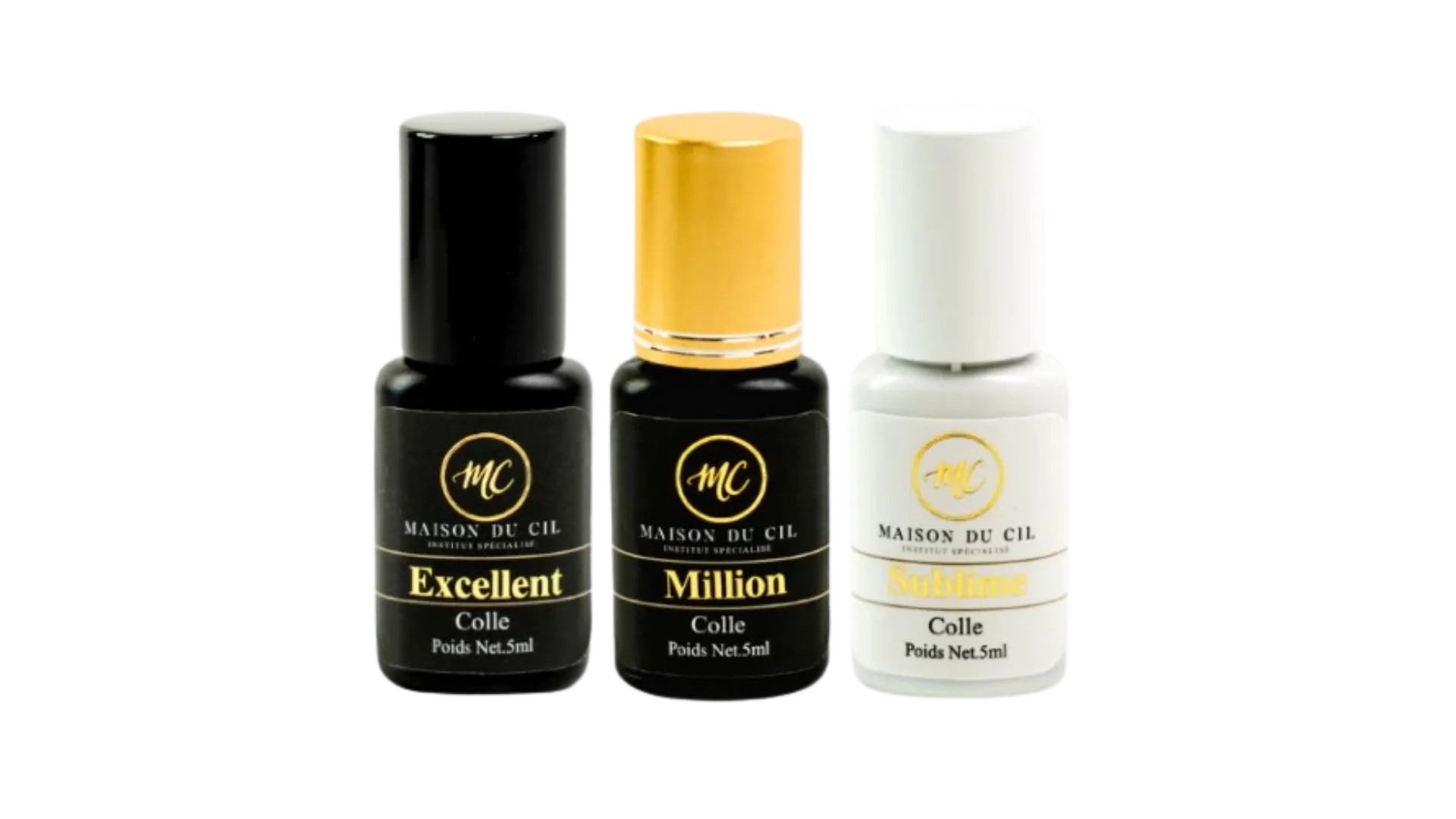
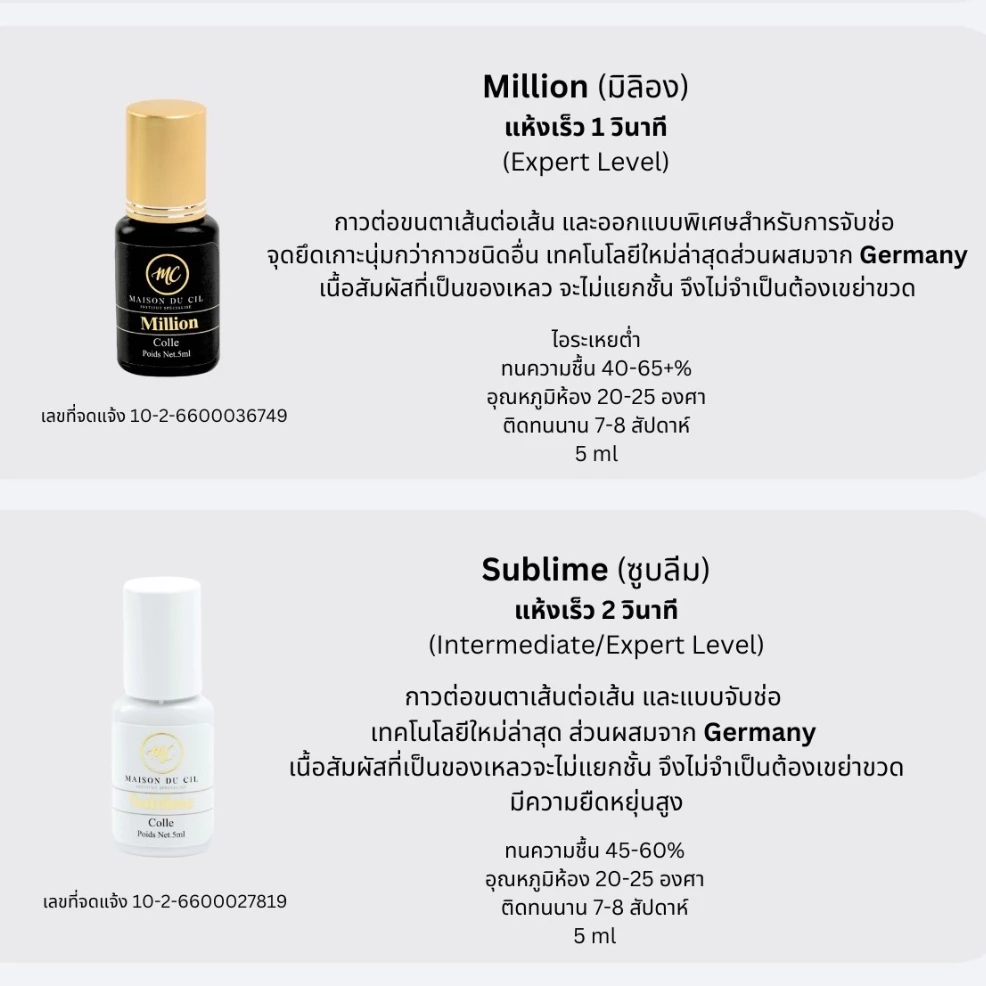
SUBLIME — 2-second set
Suits artists fresh out of training, artists coming back after a long break, and anyone who works meticulously and positions gradually.
The advantage nobody talks about is that a slower glue forgives mistakes. If your placement is slightly off, you still have time to adjust. With a fast glue you have to pull it off and start again, which costs you more time than you saved.
One caution: in a room below 40% humidity this glue can set so slowly that lashes shift. Raise the humidity in the room rather than changing glue.
MILLION — 1-second set
Suits artists who already work fluently, place accurately first time in most cases, and are starting to feel that a 2-second glue is slowing their turnaround.
This is where most artists end up long term. If you work mainly classic and your schedule is already full, this glue is usually the best fit.
EXCELLENT — 0.5-second set
Suits artists doing volume and mega volume, who place fans of several lashes onto one natural lash and need the fan to set instantly before it opens out.
If you work mainly classic, you get almost no benefit from this kind of speed, and there's a good chance your work gets worse because the glue cures before you place.
Three signs your glue is too fast for you
- Extensions twist or sit crooked often — the glue sets before you've finished adjusting the angle
- You often have to pull an extension off and redo it — the clearest sign of all
- Work drops early even though everything else is right — you're attaching already-cured glue, which has almost no bond strength
Two signs your glue is too slow for you
- You have to hold each lash for a long time before letting go — that time adds up to hours over a month
- Lashes stick together in clumps after placement — the glue still hasn't set by the time you move to the next lash
What matters more than which glue you pick
Before changing glue, make sure these three are right — because if they aren't, no glue will save you.
- Shake the bottle before every use At least 30 seconds. The components separate when it sits.
- Replace the drop every 15–20 minutes Glue that has been exposed to air longer than that thickens and behaves differently.
- Store it somewhere dark and cool But not in the fridge. The temperature difference when you take it out causes condensation inside the bottle.
How long glue lasts once opened
Opened glue has a far shorter life than most people think — generally 1–2 months after opening, even if there's plenty left in the bottle.
If you find yourself thinking “this bottle hasn't been great lately” with a brand that has always worked well, check the opening date first. Write the date on the bottle in marker every time. It's a habit that helps more than you'd expect.
In short
Choose your glue on these three things, in this order
- Your hand speed today
- The kind of work you mainly do (classic or volume)
- The humidity in your own room
Don't choose by the speed you wish you had, or by what another artist uses. Their room isn't your room, and their hands aren't your hands.
Still not sure which one to start with? Ask Kru May on LINE @maisonducil Tell us how many years you've been working and what you mainly do — we'll point you to the right one.
An online lash extension course with Kru May: learn anywhere, any time, with a French certificate and a support group that answers every question.
- Launch price
- 48 hours of early access
- A free lesson, soon
A question about your own work? Message Kru May on LINE Monday–Saturday, 10:00–19:00