





5 mistakes that make lashes fall early, and how to fix them
 Kru May
Maison du Cil Thailand · 14 September 2026
Kru May
Maison du Cil Thailand · 14 September 2026
In this article
1The lashes weren't cleaned thoroughly enough 2Placing too far from the base 3Using too much glue 4Working in conditions the glue can't handle 5Choosing a glue that's faster than your hands In short: check in this orderA client comes back saying “they only lasted a week”, and you did everything exactly the same as always. Almost every artist's first instinct is to blame the glue. But from the work we see, glue is the real cause less than a third of the time. The rest comes from the small steps around it that are easy to overlook.
These five are the ones we run into most often, in order of how common they are. Read through and check your own work against each one.
1The lashes weren't cleaned thoroughly enough
Natural lashes are permanently coated in oil from the sebaceous glands. If your client comes straight from work after a full day, plus sunscreen and foundation that have migrated down to the lash line, the glue isn't bonding to the lash at all — it's bonding to a layer of oil.
What happens is that the set looks beautiful as the client gets up from the bed, but once the oil comes through again over the next two or three days, the extensions come away in clumps.
How to fix it
- Cleanse with a dedicated lash foam every single time. No exceptions, even when the client says “I'm not wearing any makeup today”.
- Brush along the lashes properly — not a quick pass over the top — and concentrate on the base.
- Rinse completely and dry thoroughly. Leftover moisture makes the glue set too fast, before you've even placed the lash.
2Placing too far from the base
The right distance is 0.5–1 mm from the skin. Any closer and the client will be irritated; any further and the work starts to fail.
The reason is simple: a natural lash tapers as it moves away from the base. Place 2 mm out and you're attaching an extension to the thinnest part of your client's lash. Less contact area, more leverage — and it will twist off on its own within days.
How to fix it
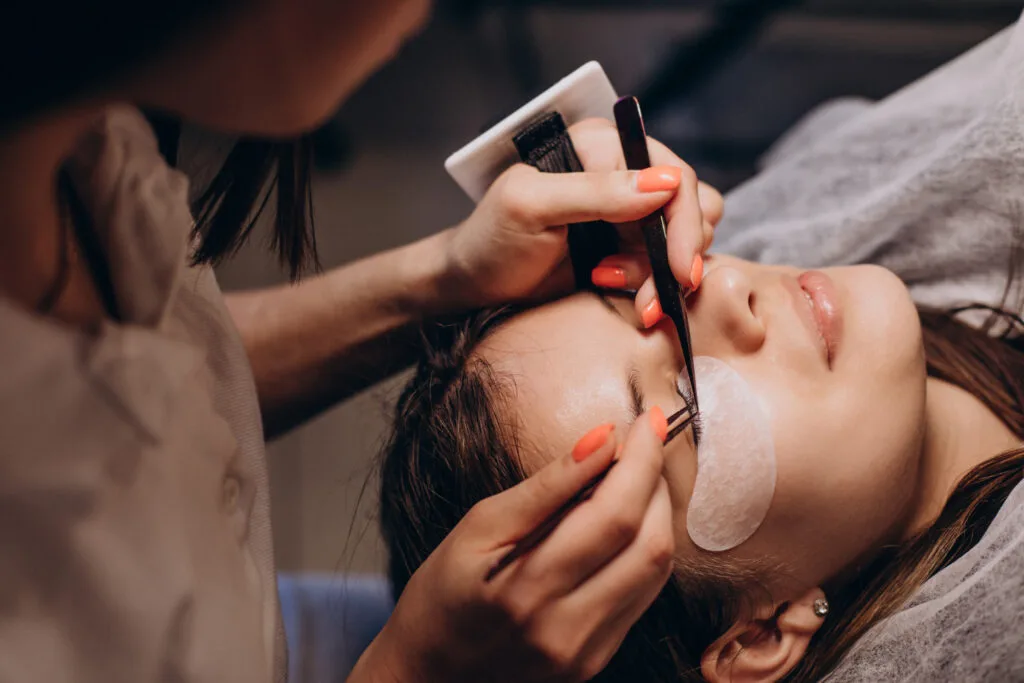
Check your own work in a mirror from the side, not from above. The side angle tells you immediately whether you're placing too far out. If you can clearly see a gap between the lash base and the extension, it's too far.
3Using too much glue
This is the one that feels most counter-intuitive to a new artist, because we assume more glue means a stronger bond. The truth is the opposite.
Excess glue dries into a hard bead around the lash. That bead has no flex, so when the client rubs their eye or sleeps on their side, the force goes straight into one natural lash instead of being distributed. The natural lash breaks or comes out along with the extension.
How to fix it
- Dip about 2 mm from the tip, and dip quickly — don't hold.
- Put out a fresh drop every 15–20 minutes. Glue that has been sitting on the pad longer than that starts to thicken, and you'll pick up more of it than you realise.
- If you can see the bead with the naked eye, it's already too much.
4Working in conditions the glue can't handle
Lash adhesive cures with humidity, not with time. This is where Thailand confuses a lot of artists, because we live in a country where humidity swings hard between seasons — and then the air conditioning pulls the moisture back out of the room.
- Humidity too high (over 65%) the glue sets faster than you can place. The outside hardens while the inside is still wet. The set looks good on day one and then drops fast.
- Humidity too low (under 40%) the glue sets slowly, extensions shift after placement, and lashes stick together in clumps.
How to fix it
Buy a hygrometer — a few hundred baht — put it next to your bed, and log the reading every time you work. After two weeks you'll see a clear pattern of which humidity range gives you your best work. Every room is different.
If the room is too dry, use a small humidifier. If it's too humid, switch to a slower-setting glue rather than forcing the one you have.
5Choosing a glue that's faster than your hands
We see this constantly in artists straight out of training. They watch a senior artist use a 0.5-second glue and want to use the same thing, forgetting that the senior artist has done thousands of sets and works far faster.
A glue that sets faster than your hand speed will dry before you've finished placing. What you're attaching is already-cured glue, which has almost no bond strength.
How to fix it
Choose your glue for the hand speed you actually have today, not the one you want to have.
- 2 seconds — new artists, or anyone who still takes time to position
- 1 second — working confidently, placing accurately first time
- 0.5 seconds — artists doing volume who need the fastest possible turnaround
There's nothing embarrassing about using a slower glue. A set that lasts 5 weeks on a 2-second glue always beats a set that drops in 10 days on a 0.5-second one.
In short: check in this order
Next time a client complains that lashes are falling early, don't change your glue first. Work down this list.
- The cleanse before you start — was it actually clean?
- Distance from the base — is it within 0.5–1 mm?
- Glue volume — can you see a bead with the naked eye?
- Room humidity that day — what was it?
- The glue you're using — is it faster than your hands?
Almost every time, the answer is in the first four.
Still not sure where your problem is? Ask Kru May on LINE @maisonducil Describe what you're seeing — we'll work through it with you.
An online lash extension course with Kru May: learn anywhere, any time, with a French certificate and a support group that answers every question.
- Launch price
- 48 hours of early access
- A free lesson, soon
A question about your own work? Message Kru May on LINE Monday–Saturday, 10:00–19:00